Best WDT Tool for Espresso (2026)
Disclosure: This guide currently contains no affiliate links. When product links are added at publish time, any affiliate relationship will be disclosed here, before the links. It will not change the picks.
The short answer
For most home baristas, the best wdt tool is the Normcore WDT Distribution Tool V3. It has nine thin needles, interchangeable needle sets, and a stand to keep it upright, which makes it the simplest upgrade to more even espresso. If you want an adjustable tool for less money, the MHW-3BOMBER WDT Tool T6126 is the value pick. If you want the cheapest way in, the IKAPE WDT tool costs around $18. If you want a premium handheld tool, the Sworksdesign WDT tool is $50. If you brew on a 58mm machine and want a cyclone-style stirrer, the MHW-3BOMBER YU Series Cyclone is the premium option at around $99.
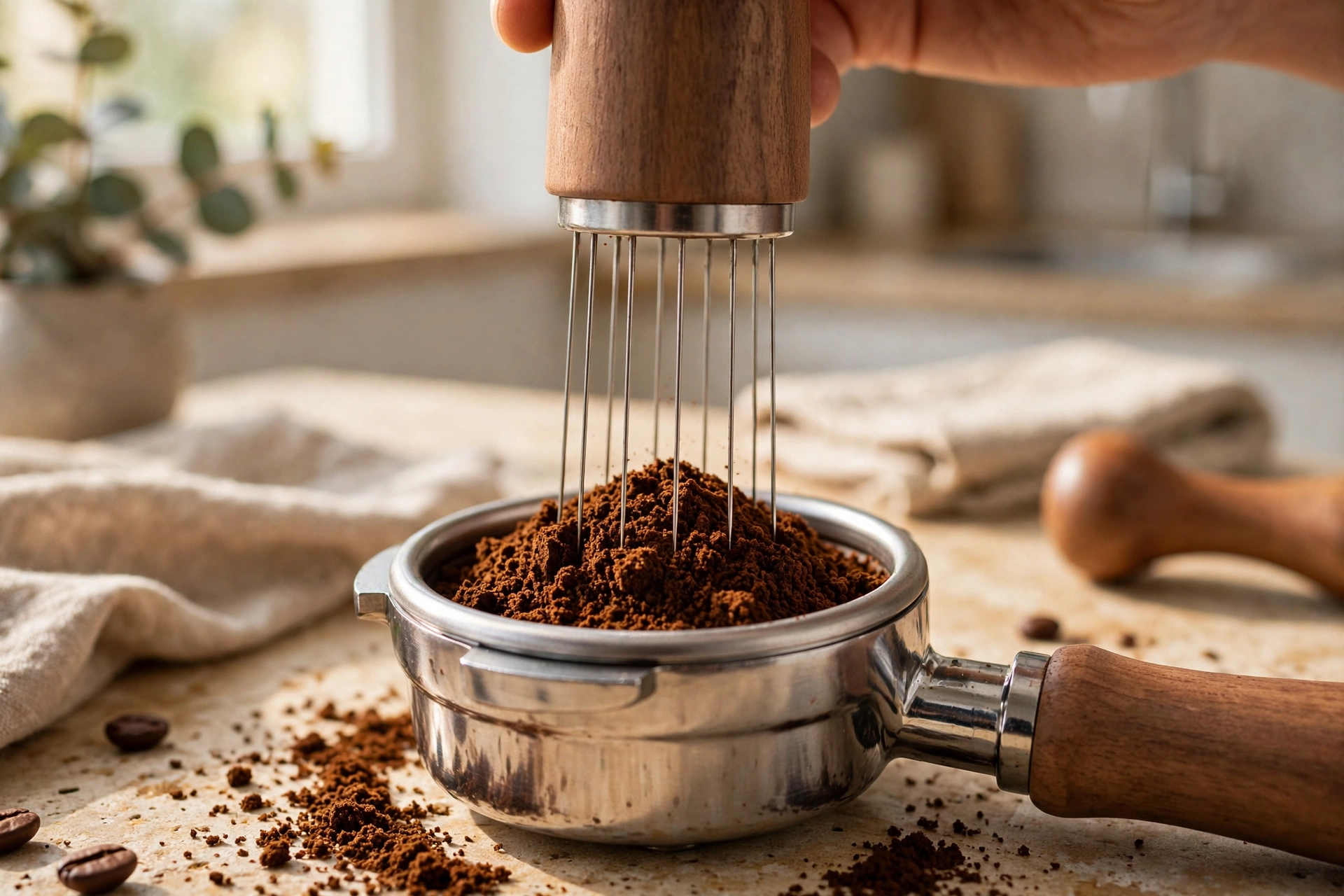
A wdt tool is a handle with thin needles that you stir through espresso grounds in the portafilter before tamping. WDT stands for Weiss Distribution Technique. After grinding, coffee sits in clumps with uneven density. Stirring breaks the clumps apart and levels the bed, so water flows through the puck more evenly instead of rushing through one channel.
How we chose these tools: this guide compares product specifications, needle design, adjustment features, included storage, basket compatibility, and reference pricing. We have not conducted hands-on extraction tests, so these picks are based on product information and practical buying considerations, not a claim that one tool produces objectively better espresso than another. Prices are November 2026 US reference prices, not guaranteed live offers, so check the live price and exact model name on the day you buy.
In this guide: quick picks | what WDT does | how to choose | 5 picks | two more options worth knowing | how to use a WDT tool | WDT vs distributor vs tapping | DIY option | mistakes | who should not buy one | buy in this order | FAQs | final decision
Quick picks
| WDT tool | Best for | Needles | Price (Nov 2026, reference) |
|---|---|---|---|
| Normcore WDT Distribution Tool V3 | Best overall | 9 prongs, 0.25mm and 0.3mm sets, stand | Around $29.99 |
| MHW-3BOMBER WDT Tool T6126 | Best adjustable value | 8 needles, 0.4mm, adjustable span, magnetic stand | Around $25.99 |
| IKAPE WDT Tool | Best budget | Multi-needle handheld, stand | Around $18.19 |
| Sworksdesign WDT Tool | Best enthusiast handheld | 0.22mm and 0.25mm ball-ended needles, angled | $50 |
| MHW-3BOMBER YU Series Cyclone T5849 | Best cyclone-style, 58mm only | 14 stirrers, magnetic base | Around $99 |
Prices are November 2026 US reference prices, not guaranteed live offers. Check the live price and exact model name on the day you buy.
What WDT actually does for your espresso
When water hits an uneven puck, it finds the path of least resistance and rushes through it. That path is called a channel. The coffee along the channel over-extracts and turns bitter, while the coffee around it under-extracts and tastes sour. The shot looks fine coming out, but it tastes muddled.
WDT breaks up clumps before they cause channels. Stirring with thin needles spreads the grounds into a level bed of even density. The tamp that follows then presses a uniform puck, and water flows through the whole bed instead of one channel. That may help create a more uniform coffee bed, but it is not a guaranteed fix for channeling or inconsistent shots. Grind size, dose, grinder performance, basket choice, and puck preparation still matter. WDT will not fix a bad grinder, stale beans, or a wrong dose, but it removes one of the biggest sources of inconsistency in home espresso.
A puck screen is a different tool. It sits on top of the puck and keeps the group head clean. It does not break up clumps, so it does not replace a WDT tool.
How to choose a WDT tool
Needle thickness is worth considering, but there is no universally established best thickness. Fine needles are commonly used for WDT because they can move through the coffee bed with less disruption than thicker rods. Very thin 0.25mm needles bend more easily if you stir aggressively or drop the tool. Needles around 0.3mm to 0.4mm are generally the best balance of flexibility and durability for home use. Thicker needles may disturb the grounds more, so avoid heavy rods. Every pick in this guide uses thin needles for that reason.
Basket size is a tamper problem, not a WDT problem. This is the correction that matters most in this guide. A handheld needle tool has a narrow needle cluster, roughly 30mm to 40mm across, which moves freely inside 51mm, 54mm, and 58mm baskets alike. The Normcore V3, for example, is 31mm across, so it works in any common basket. You do not need to match a handheld WDT tool to your basket size, and a handheld tool will not scrape the sides of a smaller basket. Size matching matters for tampers, which must fit the basket exactly. The one exception is basket-fitted and rotary tools: the Cyclone pick below is designed for 58mm baskets only, so check the manufacturer’s stated size before ordering that style.
Adjustment means different things on different tools. On the MHW-3BOMBER T6126, adjustment changes the needle span, how widely the needles cover the coffee bed, not the needle depth. On the Sworksdesign tool, you can change how many needles are fitted and their arrangement. Neither is better in the abstract; span adjustment suits buyers who want a wider or narrower stirring pattern, while a configurable needle layout suits buyers who like to tune their setup.
Keep the tool in a stand. Needles bend when a tool rolls around a drawer. A magnetic base or a stand keeps the needles upright and protected, and it keeps the tool where you can grab it every morning.
What you already own. If you already tamp with a calibrated tamper, WDT is the step that comes before it: stir first, then tamp. Our Best Espresso Tamper guide covers tampers that pair with the tools here. WDT also pairs with the machines in our Best Semi Automatic Espresso Machine guide and our Best Espresso Machine Under $500 guide, since those are the machines most home baristas stir grounds for.
Best overall: Normcore WDT Distribution Tool V3 (around $29.99)
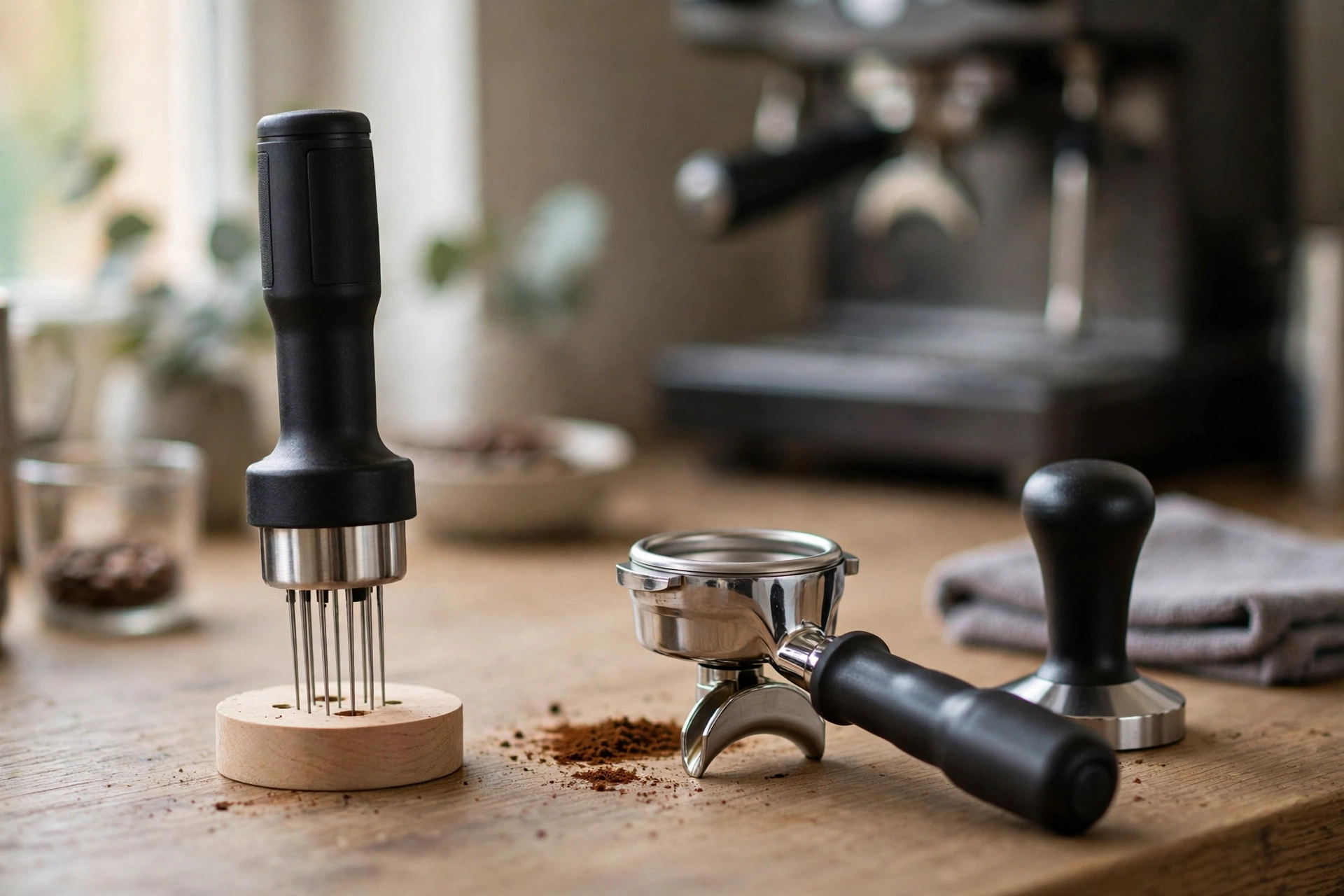
The Normcore WDT Distribution Tool V3 uses a nine-prong design and comes with a stand. Its interchangeable needle sets include 0.25mm and 0.3mm options, while the anodized aluminum body gives it a more polished look than a basic DIY-style tool. At 31mm across, it fits any common basket size, so you do not need to match it to your machine before buying. Start with the 0.3mm set if you are worried about bending needles, and keep the 0.25mm set for finer stirring. A walnut-handle variant is sold separately; the standard version has an aluminum body, so check the selected finish and included accessories before ordering.
- Pros: Nine prongs, two interchangeable needle sets, stand included, fits any basket size, simple to use.
- Cons: The 0.25mm needles bend if handled roughly. The walnut variant costs more than the standard version.
Best for: Most home baristas who want one WDT tool that just works.
Best adjustable value: MHW-3BOMBER WDT Tool T6126 (around $25.99)
The MHW-3BOMBER WDT Tool T6126 has eight 0.4mm needles, an adjustable needle span, a magnetic stand, and six spare needles. Rotate the adjustment to change how widely the needles cover the coffee bed. Its adjustable span helps you change the stirring pattern without paying for a premium tool, and the 0.4mm needles are sturdier than the thinnest options in this guide.
- Pros: Adjustable needle span, magnetic stand, six spare needles included, lower price than the Normcore V3.
- Cons: Eight needles instead of nine, and the handle is plainer than the Normcore.
Best for: Buyers who want an adjustable stirring pattern and spare needles for less money.
Best budget: IKAPE WDT Tool (around $18.19)
The IKAPE WDT tool is a straightforward multi-needle handheld tool sold on Amazon, and it is the cheapest verified pick in this guide. It does the same basic job as the tools above: thin needles, stirred through the grounds before tamping, with a stand for storage. It lacks the interchangeable needle sets of the Normcore and the adjustable span of the MHW-3BOMBER, but at roughly half the price of the best overall pick, it is a relatively affordable way to add a dedicated WDT step to a home espresso workflow. The tracked US price dates from earlier in 2026, so check the live Amazon price and the exact needle count on the listing before ordering.
- Pros: Lowest price in this guide, simple handheld design, widely available on Amazon.
- Cons: Fewer features than the picks above, and the exact needle count varies by listing, so verify before buying.
Best for: Beginners who want to try WDT without spending $30 or more.
Best enthusiast handheld: Sworksdesign WDT Tool ($50)
The Sworksdesign WDT tool is a machined aluminum tool with angled needles and two needle packs included: 0.22mm and 0.25mm ball-ended needles, ten per pack. The angled layout spreads the needles across the bed, and the maker recommends using nine needles from the insert, which holds up to seventeen. Ball-ended needles are gentler on the basket than pointed ones. The tool itself is $50 from the maker’s own shop and in stock, but the stand is sold separately, which raises the total cost, so factor that in before comparing it with the Normcore, which includes a stand.
- Pros: Machined aluminum build, angled needle layout, ball-ended needles, two needle packs included, wide color range.
- Cons: Stand sold separately, and the 0.22mm needles are the most bend-prone in this guide.
Best for: Enthusiasts who want a premium handheld tool and do not mind buying the stand separately.
Best cyclone-style, 58mm only: MHW-3BOMBER YU Series Cyclone T5849 (around $99)
The MHW-3BOMBER YU Series Cyclone T5849 is a premium option for buyers interested in a guided, cyclone-style stirring pattern. It sits on the portafilter and spins fourteen stirrers through the bed, with a magnetic base. Its design may appeal to espresso users who prefer a more structured workflow, but the higher price does not automatically mean better extraction. This is the one pick where basket size genuinely matters: it is designed for 58mm baskets only, so Breville Bambino owners should not buy it. Confirm the exact basket-size compatibility and included components before purchasing, and note that listings differ on the stirrer diameter, so check the listing you buy from rather than trusting a single figure. The reference price is around $99 from the maker’s own shop and Amazon; an earlier 2026 sale dropped it to around $69, which explains the wide price range seen in older listings.
- Pros: Guided cyclone stirring pattern, fourteen stirrers, magnetic base, structured workflow.
- Cons: Highest price in this guide, 58mm baskets only, and stirrer diameter varies by listing.
Best for: 58mm machine owners who want a guided cyclone stir and accept the price.
Two more options worth knowing
These are not counted among the 5 picks above, but both were verified on US retailer pages on November 3, 2026, so they are worth a mention.
Whole Latte Love WDT Coffee Tool ($23.99 on sale, $27.99 regular). A US espresso retailer option with a rounded wood handle. It uses stainless steel loops rather than thin needles, and the listing gives no loop thickness and no stand, so it suits someone testing the technique rather than someone chasing the finest needle gauge. If you prefer buying from a specialist US retailer instead of Amazon, this is the trial-priced alternative to the IKAPE budget pick.
Fellow Espresso WDT Distribution Tool ($39.95 at Seattle Coffee Gear). An aluminum and stainless steel tool whose needles retract when not in use, which protects them in a drawer without a separate stand. It is not a pick in this guide because it showed as sold out when checked on November 3, 2026. If it comes back in stock and you store tools in a drawer, it is worth a second look.
Comparison table
| WDT tool | Needles | Adjustment | Stand | Price (Nov 2026, reference) |
|---|---|---|---|---|
| Normcore WDT V3 | 9 prongs, 0.25mm and 0.3mm sets | Needle layout | Yes | Around $29.99 |
| MHW-3BOMBER T6126 | 8, 0.4mm | Needle span | Magnetic | Around $25.99 |
| IKAPE WDT Tool | Multi-needle handheld | No | Yes | Around $18.19 |
| Sworksdesign WDT Tool | 0.22mm and 0.25mm, ball-ended | Needle layout | Sold separately | $50 |
| MHW-3BOMBER YU Cyclone T5849 | 14 stirrers | No | Magnetic base | Around $99 |
How to use a WDT tool
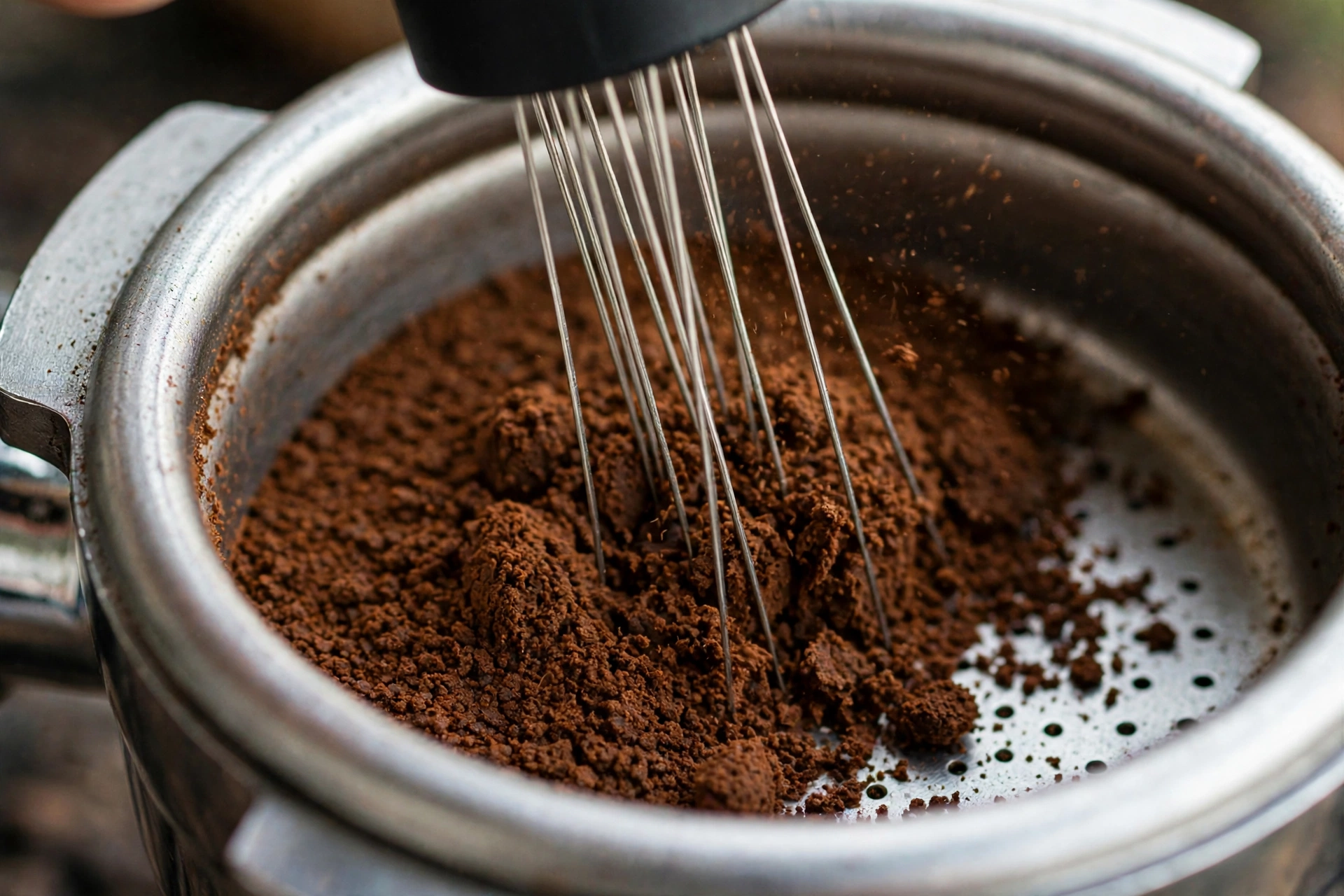
- Grind the coffee into the portafilter basket. Use a dosing funnel if it helps keep grounds from spilling.
- Insert the needles into the grounds gently, down to the bottom of the bed. Avoid scraping the basket or forcing the needles down.
- Stir through the coffee bed with controlled movements, small circles or a zig-zag, working across the basket so clumps are broken up throughout the grounds. Lift the needles out gently so the grounds do not clump again.
- Finish with a level-looking bed, then tamp evenly.
- Remove the funnel, if used, and brew.
Some baristas tap the portafilter to settle the grounds, and many skip tapping entirely, since tapping can create density layers that undo the stirring. Either way works; pick one routine and keep it consistent. With practice, WDT becomes a quick part of your workflow. If grounds stick to the needles, tap the tool gently over the portafilter before tamping.
WDT vs distributor vs tapping
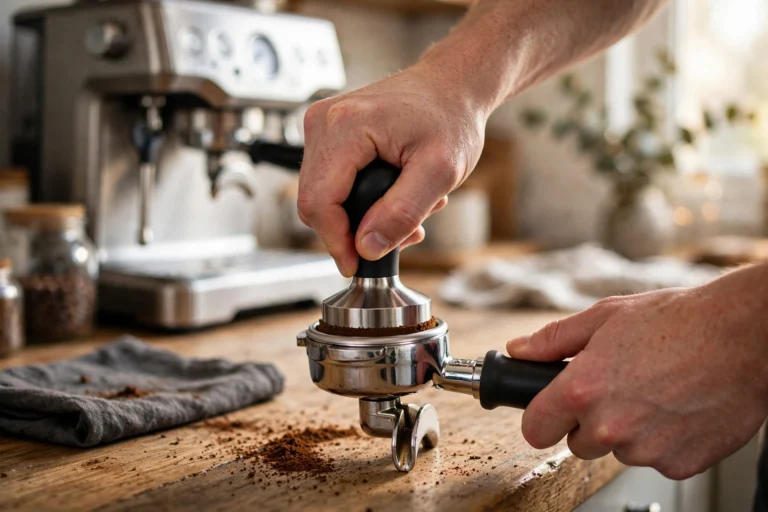
These three steps are often confused, but they do different jobs. WDT stirs the grounds to break up clumps before tamping. A tamper compresses the coffee bed. A separate surface distributor, a spinning leveler, is optional, and many home baristas can skip it if they use WDT and tamp evenly. Tapping the portafilter on the counter is a settling habit, not a distribution method, and as noted above, many baristas skip it. The essential sequence is stir, then tamp. Everything else is optional.
DIY WDT tool: cork and acupuncture needles
The classic DIY WDT tool is a wine cork with thin acupuncture needles pushed through it. It works, and it costs almost nothing, which is why it appears in nearly every WDT discussion. If you build one, use 0.3mm to 0.4mm needles, keep the needles straight and evenly spaced, and replace any needle that bends. Safety note: the needles are sharp. Keep a DIY tool away from children, store it needle-down in a cup or stand, and never leave loose needles in a drawer.
Mistakes to avoid when buying a WDT tool
- Buying thick needles. Thicker needles may disturb the grounds more than thin ones. Stick to 0.25mm to 0.4mm.
- Thinking basket size rules out a handheld tool. A handheld needle tool works in 51mm, 54mm, and 58mm baskets. Only basket-fitted and rotary tools, like the Cyclone, need a size match.
- Stirring after tamping. WDT comes before the tamp, never after. Stirring a tamped puck breaks it apart.
- Storing needles loose. Needles bend in a drawer. A stand or magnetic base protects them and keeps the tool in reach.
- Expecting WDT to fix everything. It helps distribution only. Stale beans, a wrong grind size, or a bad dose still need their own fixes.
Who should not buy a WDT tool
If you brew with pre-ground coffee and do not own a grinder, a WDT tool will help very little. Pre-ground coffee is already uniform enough that clumps are not your main problem, and grind size and dose are out of your control. Spend the money on fresh beans and a grinder first. Similarly, if your shots already taste consistent from day to day, WDT will change little.
Buy in this order
- Decide handheld or basket-fitted: handheld works with any basket size; basket-fitted tools like the Cyclone need a 58mm match.
- Decide adjustable or fixed: adjustable span or needle layout if you like to tune your setup, fixed if you always brew the same way.
- Pick the tool: Normcore V3 for most homes, MHW-3BOMBER T6126 for adjustable value, IKAPE for the lowest price, Sworksdesign for a premium handheld, YU Cyclone for a guided 58mm stir.
- Check the live price, exact model number, and variant on the day you buy.
Frequently asked questions
What is a WDT tool?
A WDT tool is a handle with thin needles used to stir espresso grounds in the portafilter before tamping. WDT stands for Weiss Distribution Technique. It breaks up clumps and levels the bed so water flows evenly through the puck.
Do I really need a WDT tool?
If your espresso workflow leaves visible clumps or produces inconsistent shots, WDT is a relatively low-cost preparation step worth trying. It is not essential for every setup, and it will not solve problems caused by grind size, dose, or grinder performance.
How many needles should a WDT tool have?
Needle thickness is worth more attention than the exact count. Eight to fourteen thin needles, 0.25mm to 0.4mm, all work well. Avoid thick rods, which may disturb the grounds instead of distributing them.
Can I use a WDT tool with a 54mm Breville basket?
Yes. A handheld needle tool works in 51mm, 54mm, and 58mm baskets because its needle cluster is much narrower than the basket. Only basket-fitted tools, like the Cyclone, are size-specific, and that pick is 58mm only.
Does a WDT tool replace a distributor or tamper?
No. WDT stirs the grounds to break up clumps before tamping. A tamper compresses the coffee bed. A separate surface distributor is optional, and many home baristas can skip it if they use WDT and tamp evenly.
Can I make my own WDT tool?
Yes, from a cork and thin acupuncture needles. It works well and costs almost nothing. Keep the needles sharp-side safe, store it away from children, and replace bent needles.
How do I clean a WDT tool?
Tap off loose grounds after each use and wipe the needles with a dry cloth. If grounds stick, rinse the needles under water and dry them before storing the tool upright in its stand.
Final decision

- Most homes: Normcore WDT Distribution Tool V3, around $29.99.
- Best adjustable value: MHW-3BOMBER WDT Tool T6126, around $25.99.
- Best budget: IKAPE WDT Tool, around $18.19.
- Best enthusiast handheld: Sworksdesign WDT Tool, $50.
- Best cyclone-style, 58mm only: MHW-3BOMBER YU Series Cyclone T5849, around $99.
Before buying, check the current US price, exact model number, and variant. Stir first, then tamp, and keep the routine consistent from shot to shot.